

Willi Gerwers (1929 – 2018)
In his retrospective account of the war years, Willi Gerwers from Bislich describes how, starting in the autumn of 1944, the conflict drew ever closer to the Lower Rhine region. At the age of 15, he and his friends were tasked with digging defensive fortifications and underwent pre-military training. In the spring of 1945, he narrowly avoided being conscripted into the Wehrmacht; he was at his family home in Bislich when the Allied forces crossed the Rhine. He notes that his father assumed that the enemy soldiers occupying his house were Canadian. It should be noted, though, that Scottish units had crossed the Rhine near Bislich. However, Willi’s father may indeed have encountered Canadians: numerous young Canadian officers served in the British Army. They had been "loaned" to the British forces starting in 1944 under the "CANLOAN" program—an arrangement necessitated by the heavy losses of infantry officers suffered by the British.
“From September 1944, events came thick and fast.
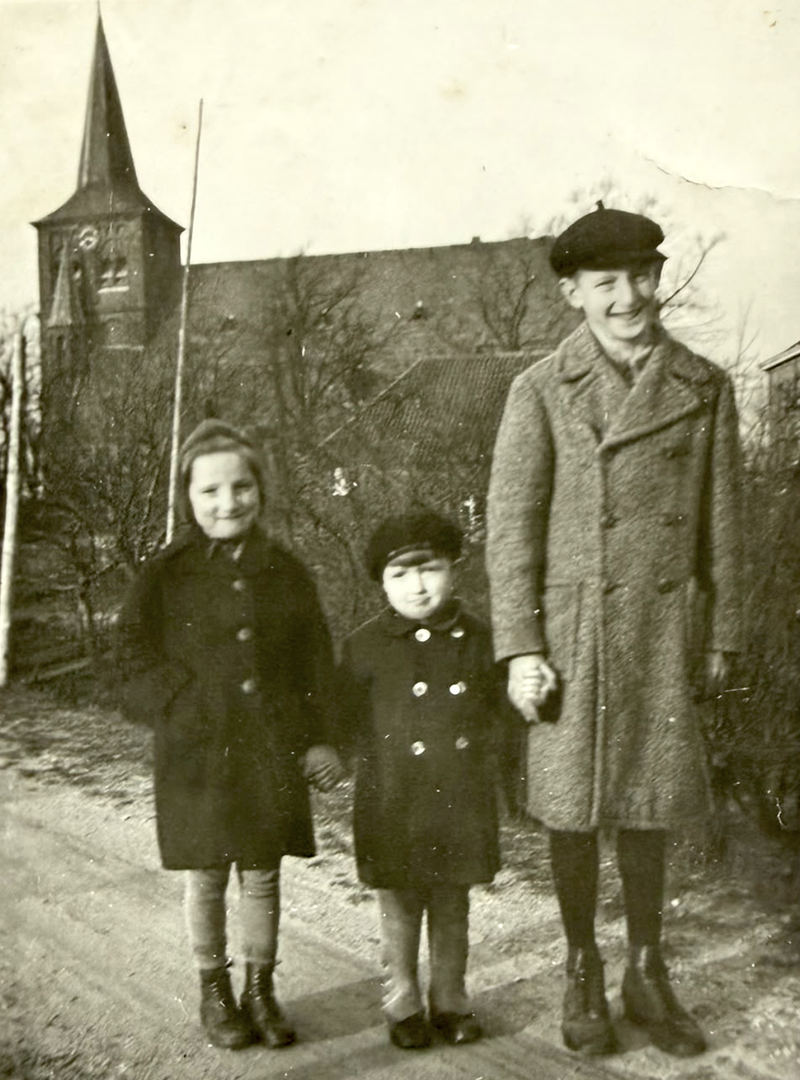
On Sunday, September 17th, Allied airborne troops had landed everywhere from Arnhem to Kleve, Kessel, and Weeze. All day long, there were appeals on the radio calling for soldiers, civilians - and everyone who could be deployed - to report to specific locations. Dad was 53 at the time and was working for the civilian Red Cross. He had to report somewhere west of the Rhine on Monday morning. I drove to Hülskens' office on Monday morning. Around noon, Mom called, and the personnel manager, Flores, told me I had to report to the train station the next morning to be detailed to dig trenches. So, I reported to Wesel station on Tuesday morning. By train we went to Kevelaer. There, at the "German House" inn we moved into the dance hall, where there was loose straw all over, and 600 15- to 16-year-old boys were allotted sleeping places in the straw. Take pity on our nasal membranes. We were tired enough. But as soon as we were asleep there came a call: "Air raid warning!" Everybody got out of the hall, outside there were trenches, some of which had large sewer pipes placed there to protect against bomb or anti-aircraft fragments. One aircraft had placed a flare to mark the target, so at least there was some "lighting." All of us tumbled into the trenches, because the aircraft returned and dropped a high-capacity bomb at Kevelaer station. We knew the difference between regular bombs and high-capacity bombs by then; as teenagers, we quickly gained war experience. Incidentally, the effect of a high-capacity bomb is amplified by the blast wave.
The next morning, we were deployed between Kevelaer and the Dutch border to build or dig an "anti-tank ditch". A deep trench in the middle, with the earth on the sides forming a wall. Days later, we were deployed to dig "fox holes" on the road between Kevelaer and Geldern. On one of these days, an aerial battle took place above us between a number of German and enemy aircraft. Some of them flew so low that we could see the pilots in the cockpits, constantly circling each other to get the enemy in their line of fire. But we were quite scared and literally lay down or crouched in the furrows of the fields.
Then we moved to Geldern and spent the night in the classrooms of the local high school. The next day, the march continued on foot to Wesel. In Büderich, we were stopped because we weren't allowed to cross the road bridge due to an alarm. In front of what was the school building back then, where the road leads to the hotel "Wacht am Rhein" , I fell asleep from exhaustion on the bare ground. Later, after we were allowed to cross the bridge over the Rhine, we were herded into the citadel (at Wesel) due to another air raid warning. We also heard that a formation had carpet-bombed the Fusternberg area of Wesel. Perhaps the raid had intended to target the train station. After the alarm sounded, we boys from the Rees district were informed by the Hitler Youth detachment leader that we could go home. What followed was a cheer - just as if a goal had been scored on a football field.
At the beginning of January 1945, I was drafted into a "Volkssturm" (militia) training course. I was still only 15 years old. The course took place at the elementary school in Bislich. We slept in the classroom where we had been taught in the 3rd and 4th grades. (…) With field exercises, rifle training (carbine), and, at the age of 15, with the “Panzerfaust” (a hand-held anti-tank weapon), the week passed quickly and wasn't particularly strenuous. A so-called "military interview" was scheduled for the last afternoon. During this interview, we were assured that if we volunteered, we still would not become soldiers as yet. "It was only about sending a signal to the Führer that the German Youth stood behind him."
I, Johannes Terfurth, Ernst Hußmann, and the two Heidemann twins, Willi and Josef, did not volunteer. Of course, the interrogators, four or five soldiers, put us under a lot of pressure. We 15-year-olds were scared but didn't volunteer. We were harassed, too, and asked if our parents had forbidden us to do so. I was afraid - if I would have answered "yes" to this question, what would they have done to Dad, who lived about 200 meters away, and I feared that he might have been imprisoned for it. They were capable of anything! Well, we persevered! And? We got our comeuppance very quickly. The five of us boys who hadn't volunteered were called up to the "military training camp" in Essen-Kupferdreh on January 28th, 1945. In a three-week military training course, we were trained on all kinds of weapons, including the newly developed "MG 42". So, at the age of 15, we learned not only to fire live ammo on training ranges but also how to maintain our weapons, disassemble and assemble carbines and machine guns. They didn't have any fully automatic rifles for us. Thank God, we never needed what we learned. (...) On Saturday, February 24, 1945, we were allowed to go home.
A "homecoming" of sorts
On Saturday, February 24th, 1945, our return train journey from Essen-Kupferdreh ended at Friedrichsfeld station. That was the final stop, as the railway line to Wesel had been destroyed. So, with our luggage we walked towards Wesel. We encountered a city that had been completely destroyed during our absence. A boy from Wesel was with us.
We walked from the station toward Hohe Straße, as it seemed to be still reasonably passable. At the first street on the left, I think it was "Am blauen Hahn," the boy from Wesel walked toward a destroyed house, his parents' house. He didn't know where his relatives were. You can't get information in a dead city! Everyone had enough to do with themselves. We continued over rubble, past dead animals, burned-out or destroyed fire trucks, and fire hoses, to the Grosser Markt (the market square). In the deathly silence, at the roundish corner house at the junction with Lomberstrasse (today the location of Schaaf’s gun store), a window blind still hanging from its ribbon rattled in the wind. Spooky. I don't think we spoke another word on the way. At the Willibrordi Cathedral, we had to climb over even more rubble to get to the wide Hansaring street.
(...)
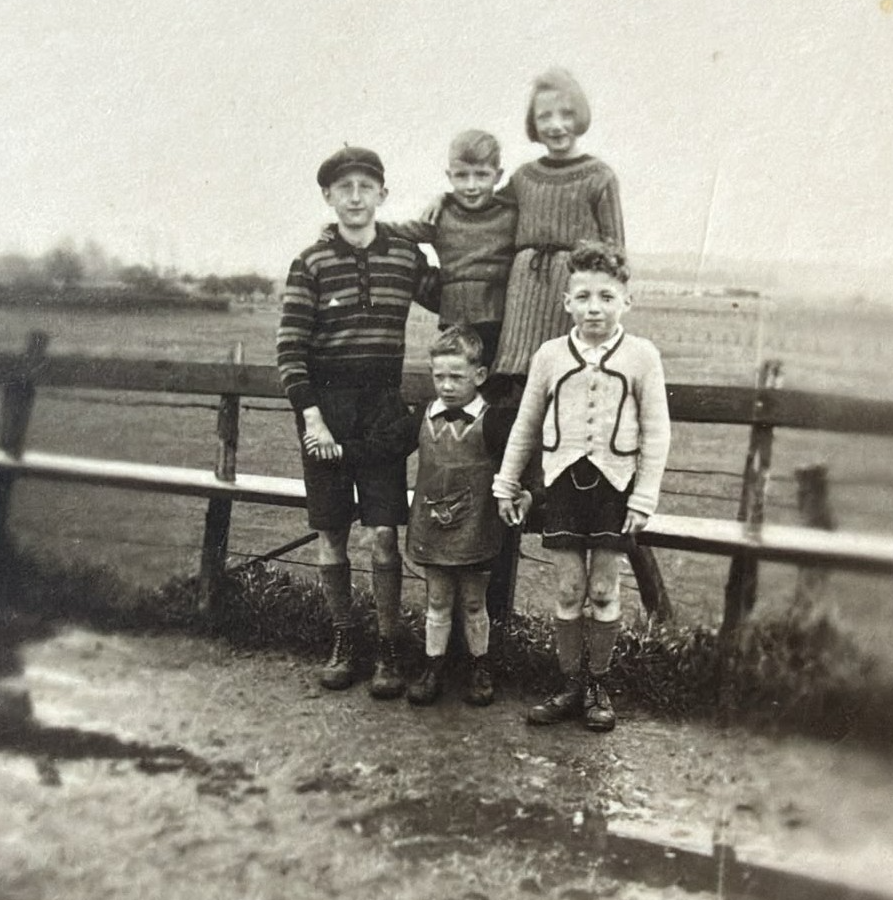
So, as 15-year-old boys (children), after profound experiences that cannot all be recounted here, and after walking loaded with luggage from Friedrichsfeld to Bislich, we happily arrived at our parents' house. Just in time!? The next day, Sunday, February 25th, 1945, at noon, the first artillery shells hit the area "an der Beek" at Xanten, near the present-day ferry landing site. At the time, we could observe this from the dyke. But that was soon to change. Over the next few days, the Xanten-Beek bridgehead, which had been used to transport military vehicles and personnel by pontoon ferries, was attacked several times a day by fighter-bombers and twin-fuselage Lightning aircraft. First fatal casualties were reported from the anti-aircraft gun positions situated there.
Since we were "Volkssturm”-trained, Johannes Terfurth and I were ordered to Scholte-Reeh's barn one evening. We were to be deployed as "dispatch riders" on bicycles. Old men from Bislich were gathered in the barn. They were the "Volkssturm"! I don't know what we were supposed to do or to dispatch. But we were recruited as dispatch riders. The two of us stayed there until midnight, then the men sent us home. They certainly had no use for 15-year-olds like Hannes and me.
Papa, who was 54 years old in February 1945, had been wounded in World War I on the battlefield of Verdun (then the largest fortress in France), and had some war experience. Fearing that in the village we were particularly vulnerable to shelling and bombing, he relocated Adele and me to Giebing, a well-known farmer in the Westerheide area. (…) Adele and I, pushing a stroller with bedding and a suitcase containing our most important belongings, made it to Giebing as darkness fell. We spent a few nights there, then in the beet cellar in the barn, which was additionally covered with plenty of straw. Especially at night, the booming of cannon and rumbling of the near and distant front was eerie. (…)
During my time at Giebing's, I was summoned to Voerde for an "army physical” (= draft registration) by a letter that arrived at my parents’ house, which was a call-up to the military in Dinslaken—bring food for three days, it also said. Dad and Mom had the courage and nerve to tell me about this only later - after the Allies had crossed the Rhine. In fact, this had constituted a clear inducement to draft dodging. In those days, one would have been court-martialled for this, and as we know, they made short work of it. (…)
March 23rd, 1945. A beautiful, sunny spring day. After lunch at the Giebing farm in Westerheide, I set off. Our old stroller was loaded with a ham, bedding on top, and across all of this a small suitcase - what belongings I had packed into it escapes me. For the first 300 meters or so, behind the dyke, I was out of sight for the enemy. To make it over the tram tracks – where there's a bicycle path today - my sister Adele helped me because of the railway sleepers. She was going to stay at Giebing’s, though. Then I – meanwhile 16 years and 20 days old – continued on alone. On the left bank of the Rhine there was an artificial smoke screen put up by the enemy, and in the distance, one could hear the sound of a spotter aircraft flying slowly over the other bank of the Rhine. Most of my route was clearly visible from the aircraft (…). Not a tree in sight, and very few houses! And this on a brilliant spring day. Other than that - no artillery fire, silence! No one knew, or even suspected, that it was the "calm before the storm." Over there, the concentration of troops for the Rhine crossing was probably taking place. I was probably only identified as a lone person pushing a stroller. In any case, it was an unforgettable experience for me, and I was glad when I arrived in the village to be sheltered by houses. There, the neighbours’ boys, Josef and Johannes Terfurth, immediately informed me about the unusual events of the last few days. (...) Suddenly, we heard the now familiar engine sounds of an approaching bomber formation. We could see and hear them dropping their bomb load over Wesel. As the last plane turned away and the explosions died down—it was around 6:00 p.m.—an artillery barrage of unprecedented fire began. Johannes immediately ran home, and Josef, during a later lull in the barrage, ran through the "Gängsken" lane between the Protestant church and the dance hall of Viljehr’s pub. From then on, all one could do was to stay in the basement. Some Bislich residents, who at that point incidentally were not close to their own houses or cellars, had to seek shelter in someone else’s cellar. Thus, many of their relatives had to make it through that night alone in their own cellar, worrying and in great uncertainty. The din of that night, the whistling, hissing, and exploding of shells all around was indescribable and will remain unforgettable for me. Fear? When smaller and larger shells hit so close? Only one wish prevails: peace at last and an end to this inferno. At times you even ducked while hunkered down in the cellar.
Dad went upstairs from time to time to check whether our house, too, had caught fire. From the side facing away from the frontline, he had seen that several houses were burning. Among them was the house owned by Stuckmann, for whom our Hermine worked. The only houses visible from our vantage point, or in the immediate vicinity, were those of Stuckmann, Wikker, Sackers, Fritz Ramms, Theo Ramms, and the parsonage of Protestant Pastor Dietz. At this time, Professor Diltey's wife, who had found accommodation at Pastor Dietz’ house, was injured by shrapnel after she left the burning house to flee home. She bled to death in the ditch next to the road, and her husband, who was lying beside her, was unable to help her. Of course, we only learned some of this later.
That night, there were nine of us in our cellar: my parents, my sisters Maria, Hermine, and Marlene, myself, Bruno, and our grandparents from Düsseldorf, who had been bombed out of their home. Naturally, sleep was out of the question that night. As I recall, it was shortly after two o'clock when things grew a bit quieter and we heard footsteps—or rather, heavy trampling—and gunfire outside. Near the top of the cellar stairs, inside the house, was a kitchen window facing the back entrance. Papa went upstairs with his hands raised.
Outside the window stood some soldiers—thank God, they were French-speaking Canadians. Papa had served in France (near Verdun) during the First World War, and he was able to use the few scraps of French he knew to make himself understood well enough to open the back door without any danger. I will never forget the sight of those soldiers—wearing camouflaged, wide-brimmed helmets and holding their rifles at the ready—descending the cellar stairs in the glow of a kerosene lamp. In truth, they only took a very cursory glance into our cellar. Papa’s assurance that only "Grandma and Grandpa" were in the back section was enough for them, even though other people could easily have been hiding back there. Afterward, the soldiers closed the cellar hatch. Later, around daybreak, artillery fire began—coming from the east, perhaps from the direction of Diersfordt—and the soldiers took cover on the lower steps of our cellar staircase. While there, they spotted Papa’s Red Cross side cap resting on a small, mesh-covered food safe near the stairs. It took all of his powers of persuasion - and every bit of French he could muster - to make them understand that he belonged to the civilian Red Cross, and was not, in fact, a medic in the army. Once the shelling from the east had ceased, they left the cellar and sat down in the room above the cellar stairs; they asked Mama to make them some "coffee"—using the coffee they had brought along themselves. She naturally assumed that she, too, might get a cup of this "real coffee"—something she had long gone without—but that was not to be.”